

Welcome to Linyi Yimengshan Global Geopark Administration!
Daigu Landforms


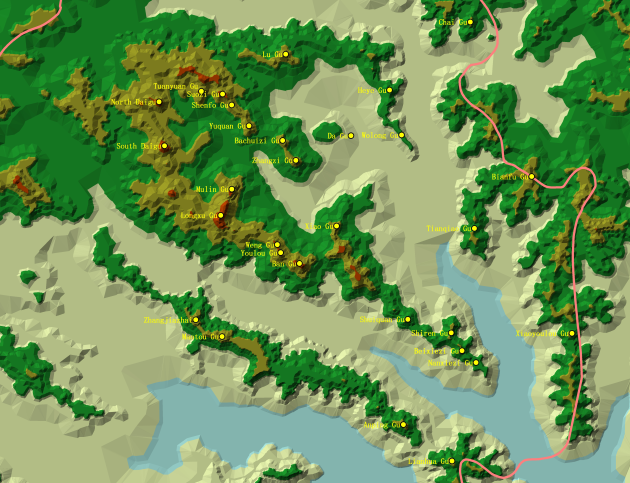
Distribution of Gu Masses

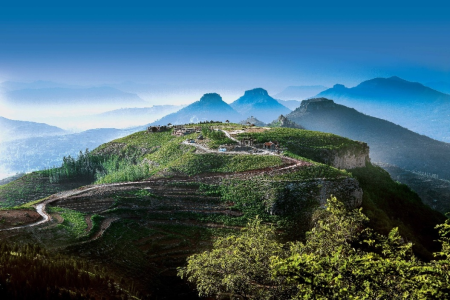
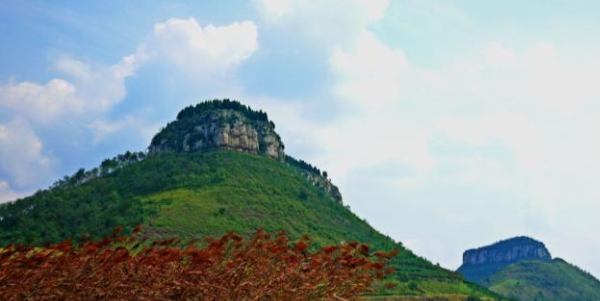
Gu masses inside Daigu Area are concentrated and extremely large in scale. Archetypal in morphology, they come in many different types. In particular, 30 gu masses have the highest research and scenic value. For their locations and morphologic features. Most of these 30 masses have limestone index beds at the top that date back to the Middle Cambrian; limestone from the Upper Cambrian has endured in only a few gu tops (e.g. Lianhuagu). In the area east of Zi River, gu masses like Xiaoyoulougu, Bianfugu and Tianqiaogu feature tops composed of Upper Cambrian rock. Very thick-bedded Middle Cambrian limestone generally emerged in mid-slopes of the central area.


Typical Daigu Landforms

Tianqiao Gu:The top of Tianqiao Gu is composed of the Late Cambrian bluish-grey limestone formed about 500 Ma ago. It is 6-8m thick and extending 200m long from north to south. As it looks very much like a manmade bridge in air, it is named “Tianqiao” (bridge in heaven). On the densely vegetated top there are ruins of redoubts, forts and fence walls built during the Liberation War.


Wolong Gu: Wolong Gu is named by its narrow extension like a crouching dragon on the hilltop. This landform is flat at its top, extending along the NE-SW direction about 20m thick, 1000m long, and 10-50m wide, representing the mature stage of Daigu (castle-shaped) landform. Here is a good sightseeing site to see the panorama of Daigu Town, the beauty and natural sight of peach forests, as well as various Daigu landscapes.


Suozi(Shuttle-shaped) Gu: Suozi Gu is long in the east–west direction and narrow in north–south one, with two tapering ends, it resembles a shuttle. Its top is flat, marked by the thick-bedded limestone about 520 million years ago. It belongs to a mature Daigu landform. It is green grass covered on its top, forming a beautiful scenery just like air grassland.


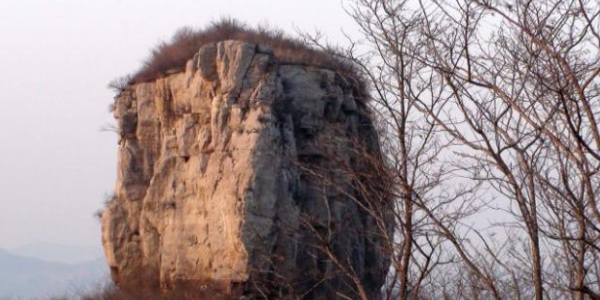
Shenfo (Buddha-patterned) Gu: Shenfo Gu extends from the northwest to southeast. Its top is composed of limestone formed about 520 million years ago. Due to the vertical joint cutting, weathering and collapse, the limestone cliff shows a Buddha face. This “Buddha” sits majestically with his back against the Shenfo Gu. The solemn face expression is extremely lifelike. It is the most lifelike natural rock Buddha found in China.


Morphological Characteristics of Daigu L andforms

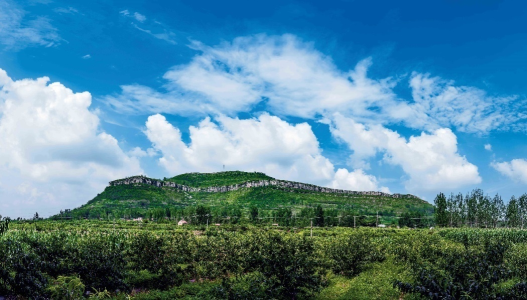
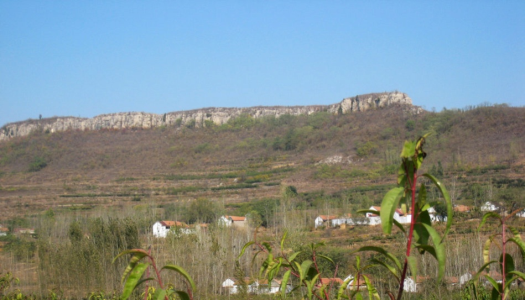
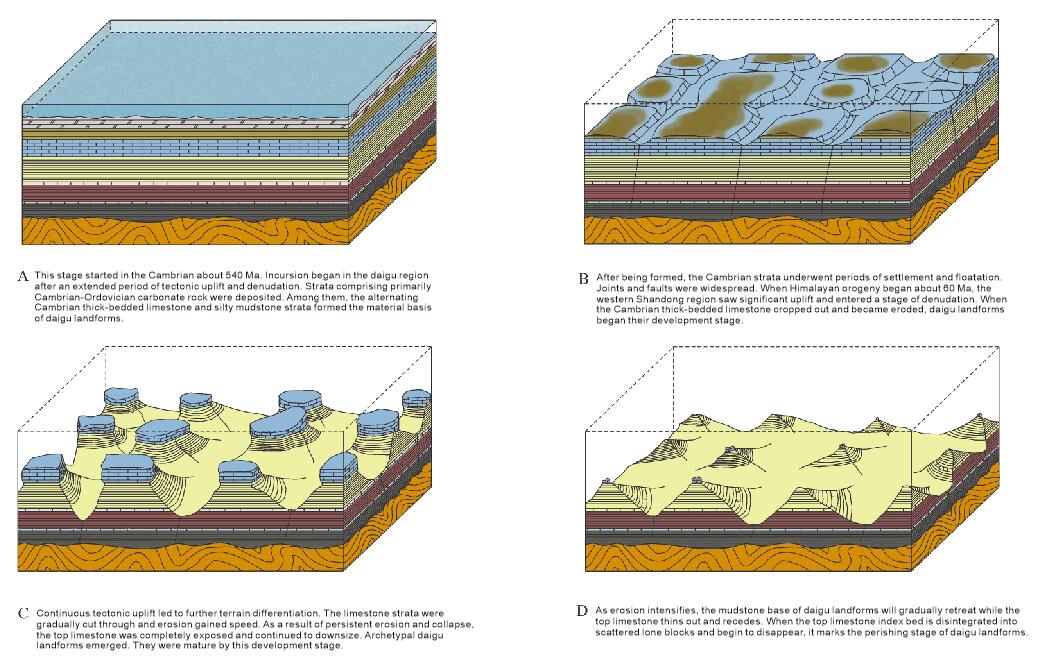
Daigu landforms manifest archetypal mensa characteristics. Mensae are usually made up of at least two upper and lower section which have different rock properties. The top rock is a distinct feature of a mensa. It is highly resistant to weathering and denudation but may contain joints. External (exogenetic) geological process and gravitation over the ages have led to landslide, reducing the structure to a typical mensa index bed with thick bedding, abrupt rock faces and flat top. The lower section is generally less resistant to weathering. Rock property is also relatively weak, mainly comprising clastic rocks like mudstone and sandy mudstone, but sometimes there are alternating mudstone and other thin-bedded rock beds. On the whole, it is thicker than the index bed on top. Affected by persistent weathering, this rock suite turned gradually into a near vertical body with gentle slopes, and a base for the mensa was formed. Daigu landforms are unique because the upper index bed is a suite of Cambrian thick-bedded limestone and the base comprises clastic rocks such as muddy (argillaceous) limestone and silty mudstone which are vulnerable to weathering.


Evolution of Daigu L andforms

Daigu landforms were formed and developed over two major stages. This suite of clastic rock and carbonate rock was formed 540 Ma in a marine facies sedimentary setting. It then came under the influence of tectonic processes. On one hand, the occurrence of faults accelerated the incision of this suite. Eventually it was cut into individual masses. On the other hand, tectonic uplift brought the suite to the surface. Subsequent weathering and erosion carved out spectacular landscapes ― a diverse and magnificent combination of daigu landforms.


CONTACT

Tel:

00-86-0539-4103881

Email:

msdzgy@126.com

Address:

Bolin Town,Mengshan Tourist District,Linyi City,Shandong

Sponsored by Mengshan Tourist Resort

Office address: Bolin Town, Mengshan Tourist Resort, Linyi City, Shandong Province

Lu ICP No. 18041240-1 Website identification code: 3713000068

Lu Public Network Security No. 37132602371358

Official WeChat
WeChat scan